

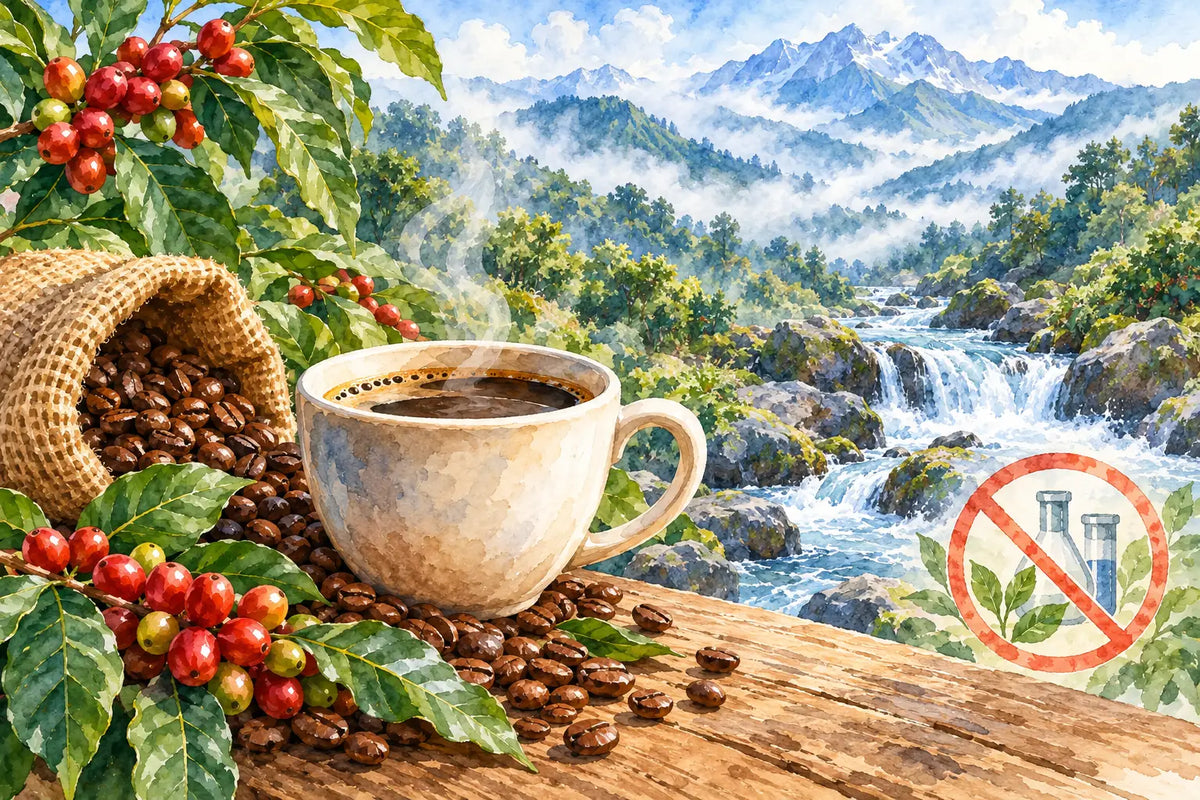
A decaf coffee should let you keep the ritual without making you question what came along with it.
That is really the point.
Maybe you want coffee after lunch without carrying the caffeine into your sleep.
Maybe you still want to make a cup at 4 PM.
Maybe caffeine simply is not serving you the way it used to.
You should not have to give up coffee altogether.
For many people, organic decaf coffee without chemicals means finding a coffee that keeps the ritual while removing a lot of the things they would rather leave behind.
But that phrase needs a little clarity.
Coffee itself is made up of naturally occurring chemical compounds. Decaffeination is also a process.
So the more useful question is not whether coffee contains "chemicals" in the broad scientific sense.
It is:
How was the caffeine removed?
Was the coffee grown organically?
Were chemical solvents used during decaffeination?
How was the coffee handled afterward?
And was the finished product actually tested?
Those are the questions we cared about when choosing how to make Seek Decaf.
Because decaf should not feel like the forgotten version of coffee.
It should be held to the same standard as everything else you drink.
What Does Organic Decaf Coffee Without Chemicals Mean?
In everyday coffee language, organic decaf coffee without chemicals usually means coffee that has been decaffeinated without relying on conventional chemical solvents.
And this is where decaf gets interesting.
Some commercial decaf coffees are processed using solvents such as ethyl acetate or methylene chloride to help remove caffeine from green coffee beans.
Ethyl acetate is a solvent that is also used in products like nail polish remover, adhesives, and other industrial applications. It can also occur naturally in foods and plants, which is why you may sometimes see ethyl acetate decaf described as "naturally processed."
Methylene chloride is another solvent used in some commercial decaffeination methods.
These processes are regulated, and there are limits around residual solvents in finished coffee.
But for us, the bigger question was simpler:
If we can make great decaf without using those solvents to remove the caffeine, why wouldn't we?
That is why Seek Decaf uses the Mountain Water Process.
No methylene chloride.
No ethyl acetate used as the decaffeination solvent.
Just a water-based process designed to remove caffeine while preserving as much of the coffee's original character as possible.
Organic decaf also begins with coffee grown under certified organic standards.
That means the coffee is produced under standards restricting many prohibited synthetic pesticides, herbicides, and fertilizers.
For us, that is the baseline.
But organic certification does not answer every question.
It does not automatically tell you how the coffee was decaffeinated.
It does not tell you whether it was tested for mold or mycotoxins.
It does not tell you how it was stored.
And it does not tell you whether someone tested the coffee instead of simply assuming everything was fine.
That is why we think a truly thoughtful decaf has to look at the entire journey.
Organic sourcing.
The decaffeination process.
Storage and handling.
Testing.
Acidity.
And, importantly, whether the coffee still tastes good.
If you want a decaf built around that standard, Seek Organic Decaf uses the Mountain Water Process, giving you the ritual of coffee without relying on conventional chemical solvents to remove the caffeine.
How Coffee Is Decaffeinated Without Chemical Solvents
Coffee is typically decaffeinated before roasting, while the beans are still green.
The challenge sounds simple:
Remove the caffeine.
Keep everything you actually like about coffee.
That second part is much harder.
Caffeine is only one of many compounds inside a coffee bean. The process needs to remove most of it without stripping away the flavor, body, sweetness, and aroma that make the coffee worth drinking in the first place.
If you are looking for decaf coffee without chemical solvents, water-based processing is one of the most important methods to understand.
Mountain Water Process Decaf
This is the process we use for Seek.
The Mountain Water Process is a water-based decaffeination method that removes caffeine from green coffee without using conventional chemical solvents like methylene chloride or ethyl acetate.
Water, temperature, time, and filtration are used to separate caffeine from the coffee while preserving as much of the flavor compounds as possible.
That distinction mattered a lot to us.
We did not want to start with organic coffee, put it through a solvent-based decaffeination process, and then call the job finished.
We wanted the decaffeination process itself to fit the same philosophy as the rest of Seek.
Know what is happening.
Remove unnecessary variables where we can.
Test instead of assume.
And do not sacrifice how the coffee tastes.
Mountain Water Process and Swiss Water Process are both water-based methods, but they are not the same proprietary process.
Seek specifically uses the Mountain Water Process.
For someone searching for organic decaf coffee without chemicals, that gives you a clear answer to one of the most important questions:
How did you actually get the caffeine out?
Without relying on the same solvents used in some conventional commercial decaf processes.
But the method alone is not enough.
You cannot take mediocre green coffee, run it through Mountain Water Process, and suddenly end up with incredible decaf.
The original coffee still matters.
Sourcing matters.
Processing matters.
Roasting matters.
Decaf should not taste like the punishment for deciding you have had enough caffeine for the day.
CO2-Processed Decaf
Another solvent-free option is carbon dioxide decaffeination.
This method uses pressurized CO2 to selectively remove caffeine from green coffee beans.
Carbon dioxide is naturally occurring, and the process can recover and reuse it.
It can be effective at preserving flavor and avoids the conventional chemical solvents that some coffee drinkers specifically want to avoid.
But again, we think the same rule applies.
Do not stop at the decaffeination method.
Ask about the coffee underneath it.
Where did it come from?
Was it organic?
How was it handled?
Was it tested?
A sophisticated process cannot compensate for poor-quality coffee.
Why We Chose Mountain Water Process for Seek
When we were deciding how Seek Decaf should be made, we did not want decaf to exist as some secondary product for people who "could not handle real coffee."
It needed to meet the same standard as everything else we make.
That meant starting with organic coffee.
It meant thinking about acidity.
It meant testing.
And it meant choosing a decaffeination process we actually felt good about.
That is where Mountain Water Process made sense for us.
Some conventional decaf methods rely on solvents to extract caffeine.
Again, those processes are regulated.
But there is still something strange about taking a product someone specifically chooses because they are trying to be more intentional, then using solvents associated with products like nail polish remover to get the caffeine out.
We knew there was another option.
So we chose it.
Mountain Water Process allows us to remove the vast majority of the caffeine using a water-based system while still protecting the flavor and character of the coffee.
That feels much more aligned with why Seek exists in the first place.
Not fear.
Not perfectionism.
Just asking a better question when a better option exists.
Organic Is Essential, but It Is Not the Whole Story
If you have ever switched to decaf and still felt like something about the coffee did not agree with you, caffeine may not be the only variable.
Coffee has a long supply chain.
It is grown outside.
Harvested.
Processed.
Dried.
Stored.
Shipped.
Stored again.
Roasted.
Packaged.
And eventually brewed in your kitchen.
That is a lot of steps.
Moisture, temperature, storage conditions, and handling all matter throughout that journey.
This was a huge part of what caused us to start asking harder questions about coffee in the first place.
Seek started because our mom was dealing with serious health challenges, and coffee was one of the things she struggled to tolerate.
Eventually we stopped asking only:
"Which coffee tastes best?"
We started asking:
What is actually in it?
Where was it grown?
How was it stored?
Was it tested?
What happened to it before it reached us?
Those questions eventually became the foundation of Seek.
That is why our standard goes beyond an organic seal.
If mold exposure, mycotoxins, or pesticide residues already matter to you, it makes sense to look for a company willing to talk about those things specifically.
Mycotoxins are compounds produced by certain molds under certain conditions.
Their presence in coffee is not inevitable.
Good harvesting matters.
Proper drying matters.
Storage matters.
And testing gives you another layer of verification instead of relying on assumptions.
The same is true for glyphosate.
Organic certification is an important starting point because it establishes how the coffee should be grown.
Testing gives you another piece of information about the coffee you are actually drinking.
You do not need to become afraid of coffee.
You can just ask better questions about it.
What to Look for in a Clean Decaf Coffee
Start with the decaffeination method.
This is probably the first thing I would look for.
If avoiding conventional solvents matters to you, look for a company willing to tell you exactly how the caffeine was removed.
"Naturally decaffeinated" sounds nice.
It does not necessarily tell you enough.
Look for something specific.
Mountain Water Process.
Swiss Water Process.
CO2 processing.
Something you can actually understand.
If the company cannot clearly explain how the caffeine came out of the bean, I would want to know why.
Then look at the coffee itself.
Is it certified organic?
For us, that is an important baseline.
Certified organic coffee gives you a defined agricultural standard rather than another vague claim about being "clean."
Then ask about testing.
This is where a lot of coffee companies stop.
A responsible company does not need to scare you about everything that could possibly be inside coffee.
But if it makes claims about mold, mycotoxins, glyphosate, pesticides, or contaminants, there should be real testing behind those claims.
We would rather test than assume.
That philosophy applies to our decaf just as much as our regular coffee.
If you are specifically looking for organic decaf coffee made with the Mountain Water Process, that is exactly why we made Seek Decaf. You can remove the caffeine without lowering the standard for everything else.
Acidity matters too.
Decaf can still be acidic.
And for someone with a sensitive stomach, caffeine may not have been the thing making the cup uncomfortable in the first place.
A lower-acid coffee can create a smoother experience.
Bean selection matters here.
Roast development matters.
Brewing matters.
The goal is not to roast every interesting flavor out of the coffee just to make it feel easier to drink.
It is to build a balanced cup from the beginning.
And finally, taste matters.
Probably more than anything.
We never wanted to make a "healthy decaf" that you force yourself to drink because you think you should.
Decaf can still have depth.
Sweetness.
Body.
A satisfying finish.
It should still give you that moment when you smell the coffee brewing and actually look forward to drinking it.
Clean standards should make great coffee better.
Not replace great coffee.
Is All Decaf Coffee Caffeine-Free?
Not completely.
Decaf coffee usually still contains a small amount of caffeine.
The decaffeination process removes the vast majority of naturally occurring caffeine, but "decaf" and "caffeine-free" are not technically the same thing.
For most people, that remaining amount is low enough that decaf serves as a practical alternative to regular coffee.
But everyone responds differently.
If you are extremely sensitive to caffeine, pregnant, managing a health condition, or following specific guidance from a clinician, your total caffeine intake may still be worth paying attention to.
This is another reason I think transparency matters.
"Decaf" is not one uniform product.
An organic coffee decaffeinated using the Mountain Water Process and backed by laboratory testing is meaningfully different from a generic decaf that tells you almost nothing about where the coffee came from or how the caffeine was removed.
The more you know, the easier the decision becomes.
When Decaf Actually Makes Sense
I think decaf gets treated unfairly.
For years, it was almost an admission of defeat.
You drank "real coffee" until you could not handle caffeine anymore, then you settled for decaf.
I think about it differently.
Decaf is a tool.
Maybe you already had two coffees and still want another cup.
Maybe it is 4 PM and you know another espresso is going to follow you into bed six hours later.
Maybe you love making coffee after dinner.
Maybe you are cutting back on caffeine for a while.
Maybe you just want the ritual without needing the stimulation.
None of those mean you suddenly stopped caring about coffee.
If anything, a great decaf lets you enjoy more of the ritual without asking caffeine to come along every single time.
I love that idea.
Coffee can be about energy.
But it can also just be about coffee.
A Better Standard for Your Daily Cup
Choosing decaf can be a small act of self-awareness.
Maybe you want coffee after lunch without sacrificing sleep.
Maybe you want the comfort of making a cup without another caffeine spike.
Maybe you are simply being more intentional about what shows up in your routine every day.
That was the standard we wanted for Seek.
Organic coffee.
Thoughtful sourcing.
Lower acidity.
Laboratory testing.
And the Mountain Water Process instead of relying on conventional chemical solvents to remove the caffeine.
No need to compromise the ritual just because you decided to compromise on the caffeine.
The best organic decaf coffee without chemicals is not defined by one phrase on the package.
It is the combination.
How the coffee was grown.
How the caffeine was removed.
How it was stored.
Whether it was tested.
How it was roasted.
And whether you actually want to drink another cup.
Your coffee should make your life simpler.
Keep the ritual.
Skip the caffeine when you want to.
Then get back to whatever matters next.
If you have been looking for a decaf held to the same standard as your regular coffee, try Seek Organic Decaf made with the Mountain Water Process.


