

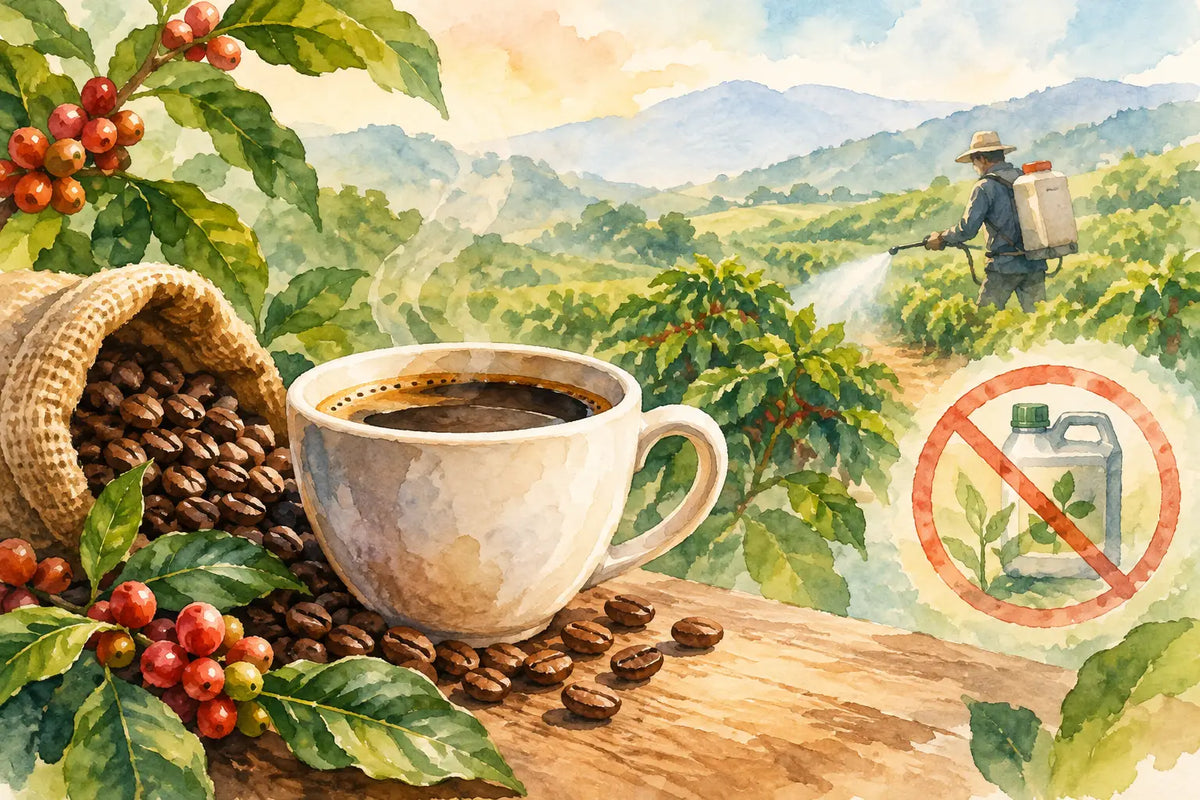
The question “does coffee contain glyphosate?” is a fair one.
Especially when coffee is not something you drink once in a while.
For most of us, it's every morning.
It is the cup before work. Before training. Before a conversation. Before sitting down to solve something difficult.
When you consume something that consistently, I think it is worth knowing more about it than the roast level and tasting notes printed on the front of the bag.
Where was it grown?
How was it grown?
What was it exposed to?
And has anyone actually tested it?
Those were the kinds of questions that eventually led us to build Seek in the first place.
Does Coffee Contain Glyphosate?
Coffee can contain glyphosate residues.
That does not mean every coffee contains glyphosate, or that every coffee represents the same level of exposure.
Glyphosate is one of the most widely used herbicides in agriculture. Depending on where coffee is grown and how a farm operates, it may be used to manage weeds around coffee plants or in the surrounding agricultural environment.
And coffee is not grown under one universal standard.
It comes from thousands of farms across different countries, climates, agricultural systems, and regulatory environments.
Then the coffee begins another journey.
It may pass through processors, warehouses, exporters, shipping containers, importers, roasters, distributors, and retailers before eventually reaching your kitchen.
That creates a lot of variables.
It is one of the reasons we stopped feeling comfortable making assumptions about coffee simply because it looked high quality or came in a beautiful bag.
For someone intentionally trying to reduce exposure to certain agricultural chemicals, “it is probably fine” may not be enough.
We would rather know.
That means asking what is actually being measured, whether the company tests for glyphosate, and whether the claims on the bag are backed by something beyond marketing language.
It is also important to separate glyphosate from mold and mycotoxins.
They are different concerns.
Glyphosate is an agricultural herbicide.
Mycotoxins are compounds produced by certain molds.
A coffee can be organic without being tested for mycotoxins. A coffee can be tested for mycotoxins without necessarily being tested for glyphosate.
This is why I think “clean coffee” should mean something specific.
Not everything bundled together underneath one vague word.
How Glyphosate Can Enter the Coffee Supply
Glyphosate is primarily used to control unwanted plant growth.
In coffee production, potential exposure can depend on the agricultural practices of the farm itself, neighboring farms, the surrounding environment, and the way coffee is handled throughout the supply chain.
There are several variables that can influence residues.
Farming practices.
Environmental drift.
Water.
Shared equipment.
Processing.
Handling after harvest.
This does not mean glyphosate contamination is inevitable.
It means that if a coffee company makes a glyphosate-free coffee claim, there should be a real process behind it.
Coffee has a long journey before we drink it.
Coffee cherries are picked.
The fruit is removed.
The beans are fermented or processed.
They are dried.
Stored.
Transported.
Roasted.
Packaged.
Shipped again.
Every one of those steps matters.
But the strongest standard starts at the farm and continues through testing.
We also do not think roasting should be treated as a shortcut.
Roasting transforms coffee. It creates the aroma, sweetness, body, and flavor we all associate with a great cup.
But simply applying heat does not replace responsible sourcing or proper testing.
If avoiding glyphosate matters to you, the better question is not:
“Does roasting remove it?”
The better question is:
Was the coffee tested?
That is ultimately what gives you something measurable instead of another assumption.
What Organic Coffee Means for Glyphosate
Certified organic coffee is one of the best places to start if reducing exposure to synthetic pesticides and herbicides matters to you.
Organic standards prohibit the use of synthetic herbicides such as glyphosate in certified organic production.
That is one reason USDA Organic became a baseline for us at Seek.
But there is an important distinction.
Organic coffee and glyphosate-free coffee are not necessarily identical claims.
Organic certification tells you how the coffee is supposed to be grown and handled under a defined standard.
It does not mean a crop exists inside a completely isolated bubble.
Neighboring farms exist.
Environmental drift exists.
Shared infrastructure exists.
Global agriculture is complicated.
That does not make organic certification less valuable.
It simply means we think testing can add another layer of confidence.
Organic tells us something important about the farming practices.
Laboratory testing helps us verify the finished product.
For us, those two things belong together.
And when coffee is something you consume every morning, choosing a higher standard for that one repeated habit starts to make a lot of sense.
No single food determines your health.
But the things you do every day deserve more attention than the things you do once a month.
Coffee is one of those things.
Why Testing Matters When Choosing Glyphosate-Free Coffee
This is probably the most important part.
If a company says its coffee is glyphosate free, there should be testing behind the claim.
Not an assumption.
Not simply an organic seal.
Not a paragraph about pristine farms.
Testing.
A thoughtful coffee company should be able to tell you whether it tests for glyphosate and what standards sit behind the claims it makes.
At Seek, this was something we cared about from the beginning.
We start with USDA Certified Organic coffee, but we do not think the organic seal means we should stop asking questions.
We use laboratory testing because we would rather verify than assume.
That philosophy extends beyond glyphosate.
It is why we also think about mold, mycotoxins, pesticides, heavy metals, and other potential contaminants when evaluating coffee.
There is another distinction worth understanding here.
“Not detected” and “zero” are not technically the same thing.
Laboratory instruments have detection limits.
Every test has a point below which a substance cannot reliably be measured.
That may sound overly technical for a cup of coffee, but the takeaway is pretty simple:
Transparency is better than absolute marketing language.
We are far more interested in a company telling us exactly what it tested for and what the results showed than seeing another gigantic “CLEAN” label printed across a coffee bag.
When evaluating coffee, look past the front of the package.
Is it certified organic?
Is it actually tested for glyphosate?
Is it tested separately for mold and mycotoxins?
Does the company explain its standards?
Those questions tell you much more than words like “natural,” “pure,” or “premium.”
You are not looking for fear.
You are looking for proof.
If that is the standard you are looking for, you can explore Seek’s regular coffee here and see how we approach sourcing, testing, and quality in the cup we built for our own family first.
A higher coffee standard often brings several things together: careful sourcing, organic farming practices, contaminant testing, proper storage, freshness, and great roasting.
Low acidity may be another consideration for people who find conventional coffee difficult on their stomach.
These are all separate qualities.
But when you combine them, you start creating a much more thoughtful coffee.
Is Glyphosate in Coffee a Health Concern?
This is where I think coffee companies need to be responsible.
The answer depends on the amount of exposure, your own health priorities, regulatory standards, and any guidance you may be receiving from a qualified healthcare professional.
A coffee company should not be diagnosing people.
And it should not use fear to convince someone to buy a bag of beans.
At the same time, regulatory limits and personal standards are not always the same thing.
Something can fall within a legal limit while an individual still decides:
“If there is an option without it, I would rather choose that.”
That is a reasonable decision.
Especially if you are already intentional about the food you eat, the water you drink, your sleep, your training, and the other things you bring into your routine every day.
You do not have to panic about coffee.
You can simply ask more of it.
That is the distinction.
Coffee should give you something useful.
Focus.
Energy.
A few quiet minutes before the day gets moving.
Maybe the ritual of making an espresso before sitting down to work.
If every cup comes with a list of unanswered questions about what might be in it, I think it is reasonable to look for a company willing to answer more of those questions.
How to Choose Coffee With Greater Confidence
Start with certified organic coffee.
That gives you a meaningful agricultural standard from the beginning.
Then look for coffee that has actually been laboratory tested for glyphosate.
Do not automatically assume that “organic,” “natural,” “clean,” or “premium” means the finished coffee has been tested.
Those words can describe a philosophy.
Testing gives you evidence.
Then look at the rest of the product.
Has the company thought seriously about mold and mycotoxins?
How does it source its coffee?
How is the green coffee handled?
Does it care about freshness?
Does it discuss acidity?
Can it tell you what it tests for without making you dig through ten pages of marketing language?
That is the bigger picture.
And taste still matters.
A lot.
We never wanted Seek to be the coffee you tolerate because you think it is better for you.
It still needs to be the coffee you genuinely want to drink every morning.
Whether that means brewed coffee, espresso, decaf, or ready-to-drink iced coffee, the same standard should carry through.
Organic.
Thoughtfully sourced.
Laboratory tested.
And actually delicious.
If you want to make that standard part of your own morning, start with Seek’s regular coffee.
It is the simplest expression of what we set out to build: great coffee, better sourcing, and testing you do not have to take on faith.
Why We Built Seek This Way
Seek® really came from one simple idea.
We wanted to know more about the coffee our family was drinking.
Our mom was dealing with serious health challenges, and coffee became one of the many things we started questioning.
At first, the questions were simple.
Why does one coffee make her feel completely different from another?
Where were these beans actually coming from?
What happened to them between the farm and our kitchen?
What were they being tested for?
Eventually, those questions got harder to ignore.
So we built the coffee we wanted to drink ourselves.
USDA Certified Organic.
Thoughtfully sourced.
Lower acid.
Laboratory tested for the contaminants we cared about rather than simply assuming they were not there.
That is still how we think about Seek today.
The goal is not perfectionism.
It is knowing more.
If there is something we can test, we would rather test it.
If there is something we can source better, we would rather source it better.
And if we can do all of that without sacrificing how good the coffee tastes, then there is really no reason not to.
Your daily coffee does not need to solve every question about health.
It is still coffee.
But something you drink every morning can reflect the same level of care you bring to the rest of your life.
Choose coffee that gives you confidence in the cup.
Then stop thinking about the coffee and go do something that matters.
If that sounds like the kind of coffee you have been looking for, try Seek’s regular coffee here.


